Skip to content

Forty years of Irish holidays, rebuilt for a phone.

Trident lets self-catering holiday homes the length of Ireland, booked direct rather than through the big platforms, so the website is the business rather than a brochure for it. We rebuilt it starting from thirty days of real session data rather than a moodboard.

At a glance Trident Holiday Homes 2025
Client
Trident Holiday Homes
Delivered with
Altitude
Year
2025
Role
UX research · Product design · Front‑end · Back‑end
Deliverables
UX analysis · Design system · Booking & search experience · WordPress build
Stack
WordPress · Elementor · Custom theme

In short

The problem
Hundreds of holiday homes across Ireland, chosen on a phone by people who have never been here.
What we built
A research-led rebuild: design system, map-and-filter search, availability and booking, on a custom WordPress theme.
What changed
A guest can search by place or by criteria and move between the two without losing where they had got to.
Web promo · 55 s

The brief

Hundreds of houses, one island, one phone screen.

Trident has been letting self-catering holiday homes across Ireland for forty years: cottages, lodges and apartments from Donegal to Wexford, booked direct rather than surrendered to Airbnb or Booking.com. That makes the website the business itself, not a brochure for it.

Which reduces the whole project to one question: how does someone who has never set foot in Ireland find the right house, out of hundreds, on a phone, before they give up and open another tab?

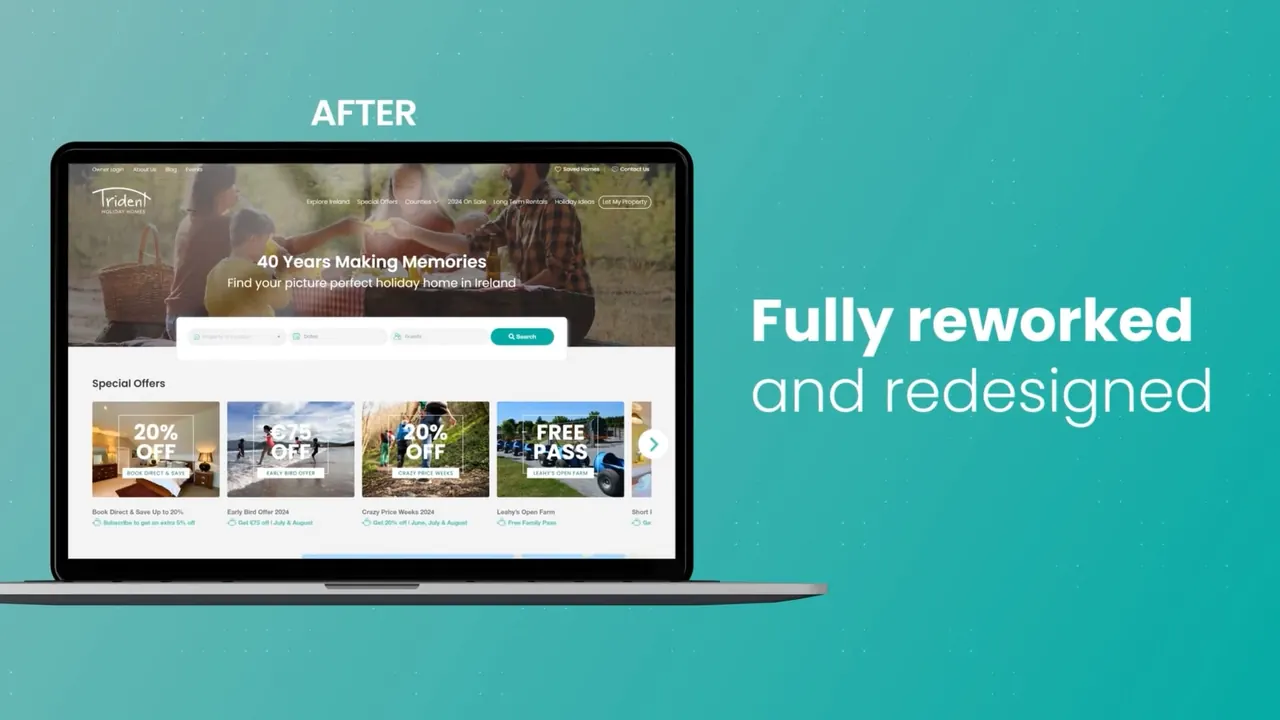
Trident Holiday Homes, search, filters, county menu and availability calendar

The evidence

We didn’t guess. We measured first.

The project opened with analysis rather than a moodboard: a month of the client’s own session data on the existing site, read in full before a screen was drawn. Three findings set the whole direction. Most of the traffic arrives on a phone. Most of it is arriving for the first time. And almost none of it knows which of hundreds of houses it wants.

Read from the client’s own analytics. The figures behind those findings belong to Trident and are not ours to publish.

Explore

A map, because a list can’t show a coastline.

Half of choosing an Irish holiday home is choosing where in Ireland to be, and no amount of sorting solves that. Explore pairs a live map with filters and a list view, so a guest can start from geography or from criteria and cross between the two without losing their place.

01

Start from the place

A live map, because half of choosing an Irish holiday home is choosing where in Ireland to be, and no amount of sorting solves that.

02

Or start from the criteria

Filters apply without leaving the map. The results narrow in place rather than throwing the guest into a separate screen and back again.

03

Cross between the two

A selection made on the map is carried into the list and back, so a guest can switch how they are searching without losing where they had got to.

Booking

From a photo to a held date, without leaving the page.

The reserve component lives on the property page rather than behind it: dates and guests are set in place, the price responds, and the guest only commits to a separate flow once they have already decided. On mobile it collapses to a fixed bar and expands on demand, so the photos keep the screen until they are needed.

Trident property page, photos, amenities, ratings and the reserve bar

The result

The same product, drawn twice.

Where, when, how many. Everything else on the site is downstream of those three answers, so the search was designed first and hardest, every awkward state drawn. Open any frame to see it full size.

Trident homepage, where, when and how many, above the fold
Explore, the live map beside the results list
A property page, photos, amenities and the reserve panel
Reserving, dates and guests set without leaving the page
A county page, Wicklow, and what there is to do there
Trident homepage on mobile, the search as a full-screen sequence
Explore on mobile, the map with prices in place
Explore on mobile, panning the map without losing the results
Explore on mobile, the same results as a list
A property page on mobile
Reserving on mobile, the summary and what is included
A county page on mobile

Some content is blurred to protect client and member data.

Under the hood

Every state drawn before a line was built.

A booking interface is mostly the moments between screens: half-filled forms, empty results, a filter that excludes everything, a selection made on a map and carried into a list. Those are the states that get invented during development when nobody drew them.

Engineered

A component library covering desktop, tablet and mobile from one vocabulary.

A custom WordPress theme on Elementor, so the client’s team owns the content without owning the layout.

Availability search across the full Irish inventory, with date range, occupancy and sorting.

A persistent bottom bar on mobile (Home, Explore, Offers, Saved), inside thumb reach.

Designed

So they were all drawn.

Around thirty states for the search tool alone, eight for the reserve component, six for the map, twelve for the navigation. The build had nothing left to guess at, and the result is a site that behaves the same on the awkward paths as on the happy one.

Stack

WordPressElementorCustom theme

See it live

Go and find somewhere to stay.

The site is live and taking direct bookings across the whole Irish inventory. Try the search on a phone. That is the screen it was designed for.

Let’s talk

Got a project
in mind?

Prefer a call?

Book a free 30-minute call

Opens a booking panel here, or a new tab if scripts are blocked. Cookie Policy.

Fields are required unless marked optional.

You’ll hear back from Mark or Adam within one working day.

We use what you send only to reply to you. See our privacy policy.

This site is protected by reCAPTCHA and the Google Privacy Policy and Google Terms of Service apply.